The asymmetry
We check the soil. Why not the system?
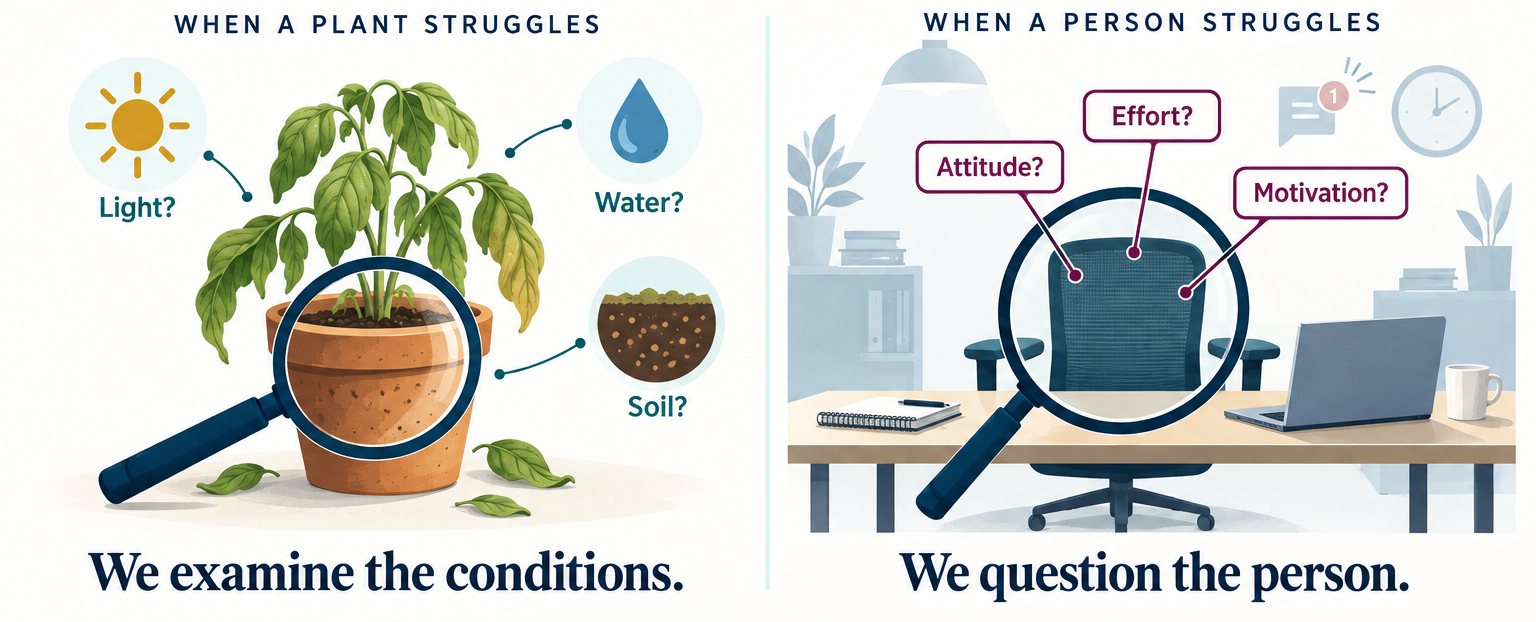
What if we investigated the conditions, too?
The WEO Framework™
Poster presented at the Stanford Neurodiversity Summit 2026
We taught a generation what neurodiversity is. Awareness changes what people notice — it was never going to change what gets built. Conditions do that, and conditions are the part nobody audits.
The WEO Framework™
Same person. Different conditions. Different outcome.
The evidence
No change
Psychological safety — identified in the 2023 study as the single strongest driver of wellbeing, career satisfaction and retention — had not improved by 2026.
61%
of neurodivergent entrepreneurs who left corporate work say they would not return to it.
~40%
received a return-to-office mandate. Half of those said it makes them reconsider staying with their employer.
Capability is not the shortage. The report describes organizational cultures that still rely “too heavily on individual coping rather than systemic inclusion.”
Figures from McDowall, A. & Srinivasan, A. (2026), Neurodiversity in Business: Research Report 2026, Birkbeck, University of London, with Neurodiversity in Business (428 neurodivergent employees, 122 entrepreneurs, 55 employer representatives). The report also records genuine gains — line manager support and career satisfaction improved, and turnover intention fell. The gap that did not close is the one conditions govern.
The WEO Framework™
Wiring × Environment → Outcome
How a person’s nervous system works: attention, sensory processing, communication, learning, regulation, strengths and needs.
Every condition a person has to operate within: sensory, relational, psychological, cultural, organizational and structural.
What we end up calling behavior, performance, burnout, belonging, growth or struggle.
Capacity possessed is not the same as capacity accessible.
Inspired by and extending Dr. Luke Beardon’s “Autism + Environment = Outcome.” The multiplication operator is my own refinement, offered for critique and testing. WEO is a conceptual and practice framework, not a diagnostic or clinical instrument. Read the white paper →
When a person fails, we check the person. That asymmetry is the whole problem — a careful, patient, conditions-first diagnostic for basil, and a blaming one-question diagnostic for human beings.
The WEO Framework™ puts the plant’s diagnostic on the human system. The operator matters: it is a multiplication, not an addition. When conditions go to zero, the outcome goes to zero, no matter how much potential is standing in the room.
This lands hardest on neurodivergent people, because the distance between what a person can do and what the room permits them to do is widest there, and because a neurotype that the environment was not built around gets read as attitude, effort or motivation. But the mechanism is not specific to us. Everyone has conditions that multiply, tax or block their capacity. Neurodivergent people are simply where the failure becomes visible first, and where it is easiest to measure.
Which is why adding more awareness to a broken environment produces nothing you can count.
The asymmetry
What if we investigated the conditions, too?
The WEO Framework™
The 2026 Birkbeck study puts it plainly: neurodivergent employees are “not a marginal group — they are a test case for whether organisations can design work that is genuinely sustainable, human-centred and future-ready.”
That is the argument I am making with this poster. Conditions-first™ is not a courtesy extended to some people. It is a design standard, and neurodivergent experience is the most sensitive instrument we have for telling us whether the design is any good.
The method
Run the loop on one person, in one room, this week.
Ask. What conditions is this person actually working in? Not the ones on the org chart — the real ones.
Compare. Where does this same person perform differently? Something is different there. Name it.
Change. Change one condition. Not the person, not six things at once. One.
Re-observe. Look again. The outcome tells you whether you changed the thing that was load-bearing.
Take the papers with you
Three companion pieces, all under one title — Not a Misfit — Misunderstood. Take the one that matches the room you work in.
From the rooms this work is already in
“Jennifer’s presentation on neurodiversity in the workplace was outstanding — thought-provoking, engaging, and highly relevant to the needs of our audience. She delivered her message with clarity and insight, complemented by a natural blend of wit and humor that kept attendees fully engaged while driving meaningful reflection.”
Monica CelisPresident, PIHRA Coachella Valley · 2025
“Jennifer’s presentation offered profound insight into neurodiversity in the workplace. Employers need coaches with her skill set to identify executives who approach goals differently. We will be working in partnership with Jennifer to develop our teams.”
Michelle DiazDirector of Employee Relations, DAP Health · 2025
“I see patterns other people miss. Not because I’m smarter. Because I’m wired differently.”
About Jennifer
Jennifer Cole Cummings is a keynote speaker, author and creator of the WEO Framework™. She spent twenty years building marketing and growth strategy for companies, and worked behind the scenes with dozens of experts and authors on their messages, books and platforms. At 44 she joined Teach For America and taught science in Baltimore, closing achievement gaps in classrooms most people had written off.
She is autistic, ADHD and dyslexic, and she knows what it is like to be the “problem” in one room and the best performer in the next. Now she helps organizations build the conditions where more people can do their best work.
Let’s check the conditions.
Or write to me directly: jennifer@jennifercummings.com
WEO is a conceptual and practice framework for designing conditions. It is not diagnostic, not clinical, and not a substitute for professional assessment or care. Jennifer Cole Cummings, M.S.Ed. · Creator of the WEO Framework™ · Palm Desert, California